I started getting a cold a few days ago.
This morning, I got up and went to work even though I was feeling pretty lousy. I have very limited time off right now because Ed and I are taking an extended cruise in a couple of months for our 25th wedding anniversary, and I am trying very hard not to use any more PTO than absolutely necessary.
On the way to work, I was really struggling and eventually decided that going to work was probably not the smartest plan I had ever made.
So I turned around, came home, went back to bed, and slept for four more hours.
But the whole thing left me thinking about something I hadn’t really thought through yet.
When we are living in an RV and waking up in different places all over the country, what happens when one of us actually needs healthcare?
Not necessarily an emergency room.
Just normal healthcare.
A doctor. An urgent care. A specialist. A prescription. An MRI.
Will our insurance work wherever we happen to be?
And somehow that question sent me straight down another retirement-planning rabbit hole.
Domicile.
Because before I can figure out what health insurance I can buy, I first have to figure out what state we are going to legally live in when we don’t have a house.
Wait. What Exactly Is a Domicile?
Once we sell the house and move into Starrs Aboard full-time, we will no longer have a traditional permanent residence.
But legally, we still need to live somewhere.
Our domicile will essentially become our legal home state. It affects things like our driver’s licenses, vehicle registrations, voting, insurance, taxes, and healthcare.
Full-time RVers tend to gravitate toward three states for the domicile:
Florida, Texas, and South Dakota.
All three are friendly to full-time travelers, all have established mail-forwarding services, and none has a state individual income tax.
That sounds simple enough.
It isn’t.
There Is a Lot More to This Than an Address
At first, I thought we would pick whichever state had the easiest residency rules and cheapest RV registration.
Then I started making a list.
Healthcare. ACA insurance for me. Medicare and Medigap for Ed. RV and car registration. RV and auto insurance. Vehicle property taxes. Mail forwarding. Voting.
And probably seventeen things I haven’t thought of yet.
Suddenly, choosing a domicile felt less like choosing a mailbox and more like choosing an entire financial ecosystem.
Healthcare May Make the Decision for Us
When we put the wheels to the road, Ed will be on Medicare, so his situation is somewhat easier. We plan to keep him on Original Medicare with a Medigap policy and Part D because we want him to have broad access to healthcare across the country.
My situation is different.
I’ll be on COBRA for a while after I retire, but eventually I’ll need an ACA plan until I’m old enough for Medicare.
And if you’re living in an RV and traveling from state to state, not every ACA plan is useful.
Some plans have narrow local networks. That’s fine if you live in one place.
It is considerably less fine if your house has wheels.
That is one of the reasons Florida is currently moving to the top of our list. Florida has PPO options that could give me broader access while we’re traveling.
But then I discovered something else.
Choosing the state isn’t enough.
Even the County Matters
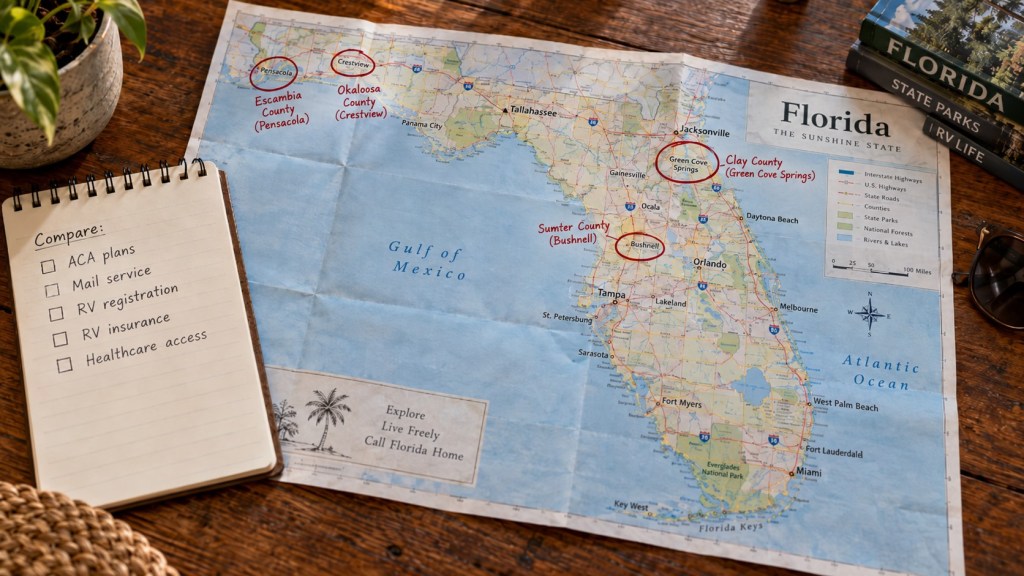
Florida has several mail-forwarding services commonly used by full-time RVers.
Escapees is in Sumter County.
St. Brendan’s Isle is in Clay County.
MyRVmail is in Okaloosa County.
American Home Base is in Escambia County.
At first glance, those are just four different places to get your mail.
Except healthcare premiums can vary significantly by county.
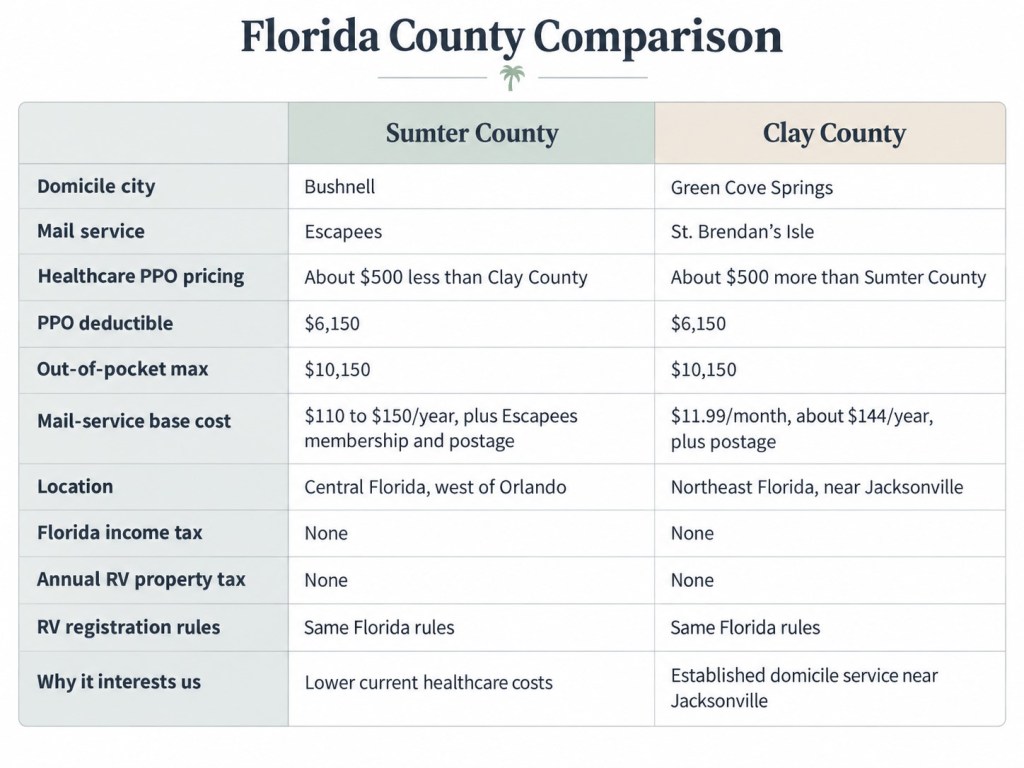
In the top two plans I compared, the difference between two counties was about $500 per month.
So suddenly the mailbox isn’t just a mailbox.
The address we choose could affect what I pay for health insurance every month.
And ACA plans and prices change every year.
Because this wasn’t complicated enough already.
So Why Does Florida Look Best Right Now?
Right now, Florida seems to check the most boxes for us.
No state individual income tax.
No annual personal-property tax on our motorhome just because we own it.
Reasonable motorhome registration costs.
Established full-time-RVer domicile services.
And, most importantly for me, promising healthcare options while we’re traveling.
Texas and South Dakota both have advantages, and either could be the perfect choice for another full-time RV couple.
South Dakota makes establishing residency remarkably easy.
Texas has a huge RV community and well-established domicile services.
But our answer doesn’t have to be everyone else’s answer.
For us, healthcare may ultimately be the thing that decides it.
And This Is Why I’m Looking at It Now
We aren’t selling the house tomorrow.
But once we do, we will need somewhere to legally live.
And I really don’t want to be sitting in the motorhome after closing on the house saying,
“So…what state do we live in now?”
There are some decisions we can make as we go.
This probably isn’t one of them.
So even though I spent a good part of today sleeping, the hours I have been awake and researching all of this have worn me out.
For now, Florida is looking pretty good.
But it’s just a start.
The decision will have to wait a few more months until the 2027 ACA plans and prices come out. And even those could change before I actually need ACA coverage in 2028.
There is a LOT that can change in two years.
For now, Florida is penciled in.


Leave a Reply